Thursday, January 28, 2010

In 1987, Sudan's Muslim government pronounced death to all males in the Christian south: 27,000 boys fled to Ethiopia on foot. In 1991, they were forced to flee to Kenya; 12,000 survived to live in a U.N. camp in Kakuma. Archival footage documents the 1,000 mile flight; we see life in the camp. We follow three young men who repatriate to the U.S. John Bul Dau goes to Syracuse, and by the film's end, becomes a spokesperson for the Lost Boys and Lost Girls of Sudan; Daniel Abol Pach and Panther Bior go to Pittsburgh. All work several jobs, send money back to the camp, search for relatives lost in the civil war, acclimatize to the U.S., seek an education, and miss their homeland.

Amazing documentary! A terribly awful situation at first, with graphic footage of these young boys completely sick and desecrated as they arrive at the camps, turns into a hopeful and uplifting story. One of the lost boys goes from feeling that the only explanation for their struggles was that "God grew tired of us" to stating that he knew that God made him the way he was to serve a purpose.

When they arrive in America, they have to learn about refrigerators, about how to use a toilet and toilet paper. They are told that they don't have to share beds. And, they are informed that their most important asset is their radio alarm clock because "In America, time is money." Gives a really interesting perspective of American culture, coming from the eyes of these humble African men.

Really fabulous film. Amazingly heartbreaking stories, but uplifting as these men are working hard to make livings, get educations, and help their friends and families back in Africa.

Sunday, January 24, 2010

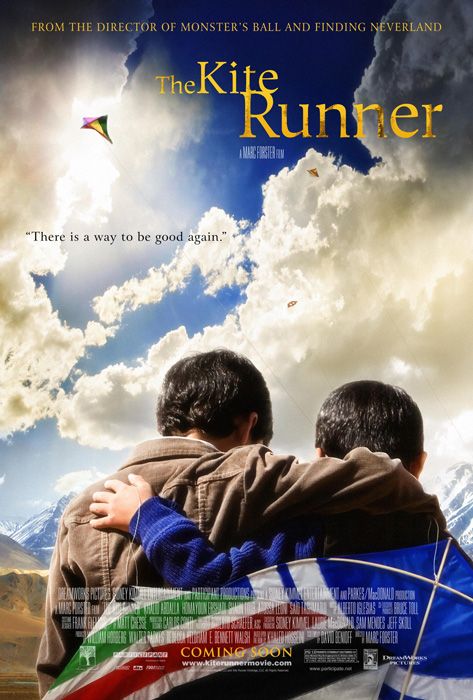
The Kite Runner

The Kite Runner is a 2007 film directed by Marc Forster based on the novel of the same name by Khaled Hosseini. It tells the story of Amir, a well-to-do boy from the Wazir Akbar Khan district of Kabul, who is tormented by the guilt of abandoning his friend Hassan, the son of his father's Hazara servant. The story is set against a backdrop of tumultuous events, from the fall of the monarchy in Afghanistanthrough the Soviet invasion, the mass exodus of refugees to Pakistan and the United States, and the Taliban regime.

So I loved the book, and I was a little disappointed with the movie in the respect that it didn't do the same thing the book did. But that is to be expected. The movie didn't give as intense insight from Amir's perspective--his internal struggles and serious guilt and shame conflicts. The book was really good at being gruesome, in a sense. It left nothing to question. The movie, I felt, tried to find the glimmers of hope or optimism and magnify those...which perhaps makes for a more welcomed movie. The ending of the movie is more conclusive than the book, as I remember it, but still leaves you feeling somewhat unsatisfied. Did Amir do enough to make things right?

Saturday, January 23, 2010

Vitus

A young boy whose remarkable, almost supernatural capacity for learning prompts his parents to anticipate a brilliant future as a pianist rebels to take his fate into his own hands in director Fredi M. Murer's contemplative family drama. By kindergarten Vitus is reading encyclopedias, and by age five he is a piano prodigy. Despite the fact that his parents do their best to nurture the young boy's natural talent for music, Vitus seems strangely disinterested in refining his exceptional talents on the ivory. In fact, the only place where Vitus seems to be in his element is in his eccentric grandfather's cluttered workshop. Now, as the young boy begins to display a keen interest in aviation, one fateful leap will set his entire future into motion, and offer a compelling preview of things to come.

Absolutely loved this movie! It's funny and inspirational, and I just can't imagine being as brilliant as this little kid. He's cheeky in school, being under-stimulated, and his teachers get mad at him for it. He doesn't care to know what river runs through a certain valley, and doesn't think that makes his teachers any smarter than him. His question is this: If teachers are always smarter than their students, why didn't the teacher of James Watt (inventor of the steam engine) invent the steam engine himself?

Friday, January 22, 2010

Shrek 2

Shrek has rescued Princess Fiona, got married, and now is time to meet the parents. Shrek, Fiona and Donkey set off to Far, Far Away to meet Fiona's mother and father. But not everyone is happy. Shrek and the King find it hard to get along, and there's tension in the marriage. It's not just the family who are unhappy. Prince Charming returns from a failed attempt at rescuing Fiona, and works alongside his mother, the Fairy Godmother, to try and find a way to get Shrek away from Fiona.

Fabulous new character: Puss in Boots

Tuesday, January 19, 2010

Adam

Soon after moving in, Beth, a brainy, beautiful writer damaged from a past relationship encounters Adam, the handsome, but odd, fellow in the downstairs apartment whose awkwardness is perplexing. Beth and Adam's ultimate connection leads to a tricky relationship that exemplifies something universal: truly reaching another person means bravely stretching into uncomfortable territory and the resulting shake-up can be liberating.

What the heck was that! Such an amazingly cute movie. I loved the whole thing...EXCEPT THE END! I won't spoil it, but the ending totally was not what I wanted to watch tonight. Adam has Asperger's Sydrome and the cute school teacher falls for him and learns how to make this awkward relationship work. Adam is such an innocent charmer, but socially awkward and can't handle his emotions. Ugh...but why did the ending have to be what it is?

Another amazing part about this movie is a specially written song by Joshua Radin (who I love). Unfortunately, the song only comes with the purchase of the whole album on iTunes.

Sunday, January 17, 2010

Casablanca

Casablanca is a 1942 American romantic drama film directed by Michael Curtiz, starring Humphrey Bogart, Ingrid Bergman and Paul Henreid and featuring Claude Rains, Conrad Veidt, Sydney Greenstreet and Peter Lorre. Set during World War II, it focuses on a man torn between, in the words of one character, love and virtue. He must choose between his love for a woman and helping her and her Resistance leader husband escape from the Vichy-controlled Moroccan city of Casablancato continue his fight against the Nazis.

A great classic, of course. It seemed to me, however, like some of the supporting actors had more interesting characters than the main stars. Humphrey Bogart is fabulous at the swarthy, cool saloon owner, but some of the random workers or army guys with strange personalities and voices are pretty great. I kept trying to imagine what colors everything really was and found that it was quite hard! What color are the walls in the Cafe Americain? What color is Ingrid Bergman's silky dress? I couldn't imagine anything...it's just too classic in black and white!

Here's lookin' at you, kid

Saturday, January 16, 2010

The Diving Bell and the Butterfly

The Diving Bell and the Butterfly is a translation of the French memoir Le scaphandre et le papillon by journalist Jean-Dominique Bauby. It describes what his life is like after suffering a massive stroke that left him with a condition called locked-in syndrome. It also details what his life was like before the stroke.

On December 8, 1995, Bauby, the editor-in-chief of Elle magazine, suffered a stroke and lapsed into a coma. He awoke 20 days later, mentally aware of his surroundings but physically paralyzed with the exception of some movement in his head and eyes (one of which had to be sewn up due to an irrigation problem). The entire book was written by Bauby blinking his left eyelid, which took ten months (four hours a day). A transcriber repeatedly recited a French language frequency-ordered alphabet (E, S, A, R, I, N, T, U, L, etc.), until Bauby blinked to choose the next letter. The book took about 200,000 blinks to write and an average word took approximately two minutes. The book also chronicles everyday events for a person with locked-in syndrome. These events include playing at the beach with his family, getting a bath, and meeting visitors.


Classic foreign film. It reminded me of this Spanish movie we watched in high school, The Sea Inside, but more extreme--meaning the main character (who is also the bad guy in Quantum of Solace) had more disabilities. It was pretty slow at some parts, especially the beginning, but once it got going it was engaging. A thinker, not really an entertainer. I wish there had been more description about his change of heart...how he went from wanting to die to refusing to pity himself. It did make me want to read the book he wrote. He seemed like a beautiful writer.


Overall, worth seeing if you are in the right mood.